An illustrated guide · 1076–1330 AH / 1666–1912 CE

Alaouite Qur’ans

Dated Qur’ans with a known copyist or patron from the Alaouite period up to 1330 AH / 1912 CE: the ones that have come down to us, and the ones recorded in the sources.

The Alaouite period is the closest to us, and its manuscript Qur’ans are plentiful in Moroccan libraries, but few have been studied and described in print. Here we present what we found in published sources: the Qur’an of Prince ʿAli in Cairo, the Qur’ans of a rural woman copyist in the Royal Library, the rabʿa of al-Qandusi in Meknes, and the first Qur’an lithographed in Fez. The guide stops at 1330 AH / 1912 CE, the year of the French Protectorate.

Browse the Qur’ans Overview table
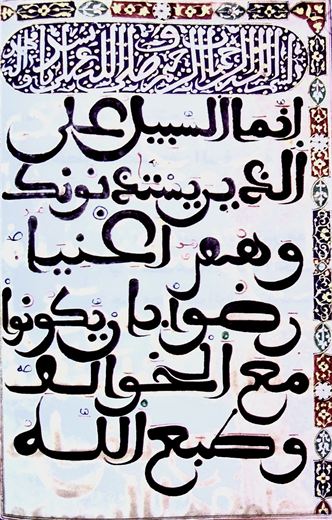
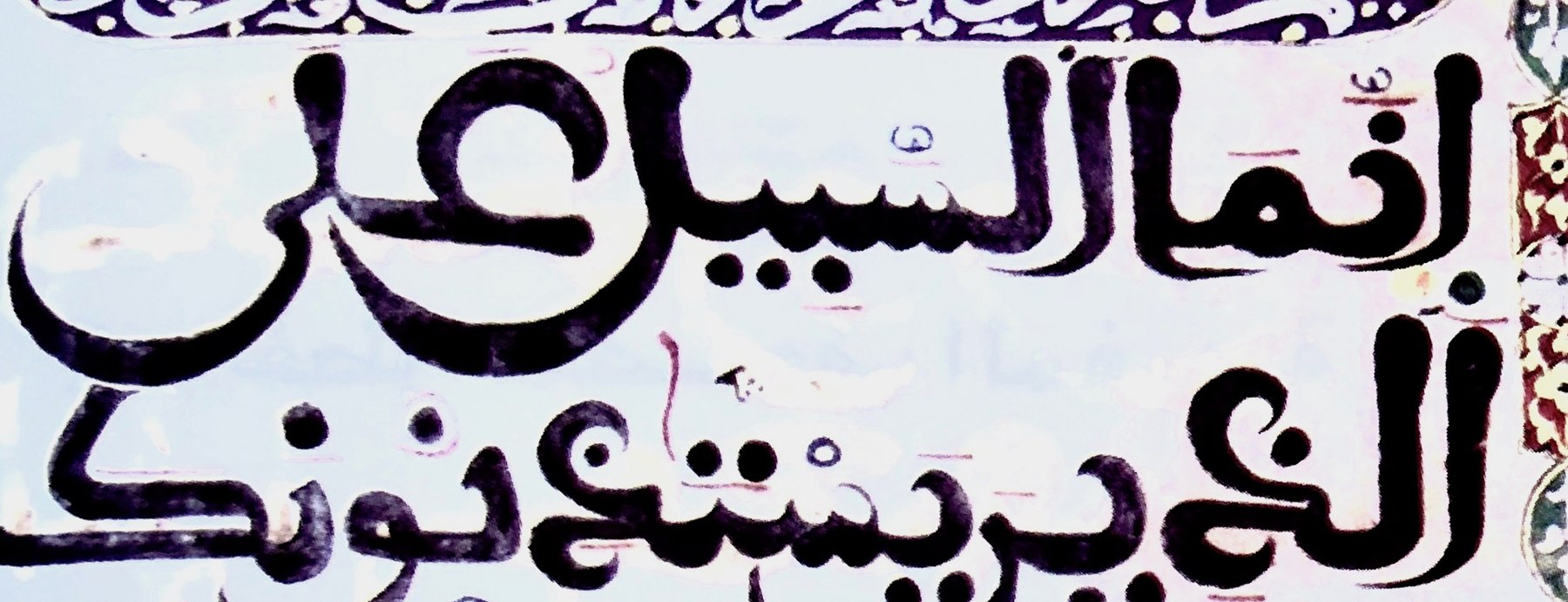
“Innamā l-sabīlu ʿalā lladhīna yastaʾdhinūnaka” in the hand of al-Qandusi
«إنما السبيل على الذين يستئذنونك», “The blame is only on those who ask your leave”: al-Tawba 93, the opening of volume 5 of a rabʿa in the hand of Muhammad b. Abi al-Qasim al-Qandusi, c. 1266 AH / 1850 CE. After Afa and al-Maghrawi, al-Khatt al-maghribi: tarikh wa-waqiʿ wa-afaq, via Wikimedia Commons.
Overview

What do we know?

This guide lists 8 Qur’ans in three groups: those that survive and meet the criteria, those recorded in the sources and since lost, and those on the edge of the criteria.

3
surviving Qur’ans meeting the criteria
3
Qur’ans recorded in the sources, with no known trace today
2
Qur’ans on the edge of the criteria, included for comparison
0
Qur’ans whose surviving parts can be browsed in full at the source

Criteria

A Qur’an enters the first list when three things hold:

  • The date of copying is stated explicitly in its colophon or endowment deed, not inferred from its style.
  • Its owner is known: the copyist, if named, or the person for whom or for whose library it was made.
  • It was demonstrably copied in Morocco under the Alaouites.

The Alaouite period began when Mawlay al-Rashid entered Fez in 1076 AH / 1666 CE. Some colophons do not give the place of copying, so we count a Qur’an as Moroccan when its copyist or the person it was written for lived in Morocco and nothing points elsewhere.

What the badges mean

Each card carries three badges: does the Qur’an survive? Is it complete? Can it be browsed online?

SurvivesLostCompleteIncompleteFully digitisedPartial imagesNot digitisedUnknown
SampleQur’anDateStateCompletenessDigitisationWhere todayBrowse
Surviving, meeting the criteria
Prince ʿAli’s Qur’an (Cairo)More about it → 1142 AH
1729–1730 CE
Survives Completeness unknown Not digitised Cairo —
—ʿAʾisha al-Takiyya’s Qur’ans (Rabat)More about it → 1237 AH and 1245 AH
1822 CE and 1830 CE
Survives Completeness unknown Not digitised Rabat —
Al-Qandusi’s rabʿa (Meknes)More about it → Friday, end of Shawwal 1266 AH
c. 6 September 1850 CE
Survives Completeness unknown Not digitised Meknes —
Recorded in the sources, now lost
—The Qur’ans of the sharīfa Fatima bint ʿAli al-ZabadiMore about it → Before 1142 AH
before 1730 CE
Lost — — Lost —
—The twenty-three Qur’ans Mawlay ʿAbd Allah sent to the Prophet’s MosqueMore about it → 1155 AH
1742–1743 CE
Lost — — Lost —
—The Qur’ans of Muhammad b. al-Hajj Muhammad al-Rifi al-TamsamaniMore about it → Before 1313 AH
before 1896 CE
Lost — — Lost —
On the edge of the criteria
—Amina’s Qur’an (Tetouan)More about it → c. 1227 AH
1812 CE
Survives Completeness unknown Not digitised Unknown —
—The Fez lithographed Qur’anMore about it → 1296 AH
1878–1879 CE
Survives Complete Not digitised Copies in various collections —
Timeline

Qur’ans in the reigns of the sultans

The bars are the reigns of the main rulers and the markers are the Qur’ans. A filled marker is a surviving Qur’an, a hollow one a lost Qur’an, and a horizontal line the span within which an undated Qur’an falls.

1660168017001720174017601780180018201840186018801900al-RashidIsmaʿilThe sons of IsmaʿilMuhammad IIISulaymanʿAbd al-RahmanMuhammad IVal-Hasan IʿAbd al-ʿAziz and ʿAbd al-HafizThe Qur’ans of the sharīfa Fatima bint ʿAli al-Zabadi — Before 1142 AHFatima al-ZabadiThe Qur’an of the Alaouite Prince ʿAli — 1142 AHPrince ʿAli 1142The twenty-three Qur’ans Mawlay ʿAbd Allah sent to the Prophet’s Mosque — 1155 AHGift of 1155The Qur’an of Amina bint al-Hajj ʿAbd al-Latif — c. 1227 AHAmina 1812The Qur’ans of the woman copyist ʿAʾisha bint Mubarak al-Takiyya — 1237 AH and 1245 AHal-TakiyyaThe rabʿa of Muhammad b. Abi al-Qasim al-Qandusi — Friday, end of Shawwal 1266 AHal-Qandusi 1266The first Qur’an lithographed in Fez — 1296 AHLithographed Qur’an 1296The Qur’ans of Muhammad b. al-Hajj Muhammad al-Rifi al-Tamsamani — Before 1313 AHal-Tamsamanisurvivingedgelost
Click a marker to jump to its card. On a phone, swipe the timeline sideways.
The Qur’ans

Cards and samples

The samples are close-ups of the writing itself, not of the illumination or the opening pages. Click a sample to enlarge it; you can zoom and pan, and follow a link to the full page at the library that holds the manuscript.

Surviving, meeting the criteria 3

1

The Qur’an of the Alaouite Prince ʿAli

1142 AH · 1729–1730 CE
Page of this Qur’an →
SurvivesCompleteness unknownNot digitised
Owner
Written for the Alaouite Prince ʿAli, grandson of Sultan Mawlay Ismaʿil, according to al-Manuni; Khabta says it was written for the library of Sultan ʿAbd Allah b. Ismaʿil
Copyist
Not named in the sources available to us
Today
Cairo, Egyptian National Library (Dar al-Kutub), Masahif 25
Format
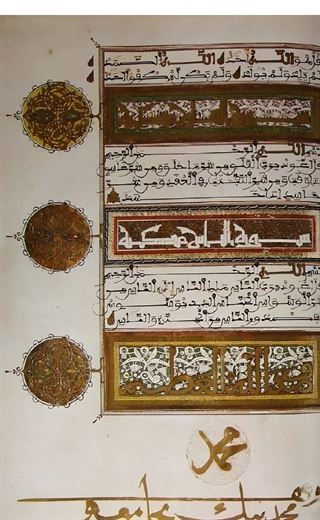
Maghribi script with Andalusi features, adorned and decorated in gold and colours; the last sura headings in gilded panels, and coloured rosettes in the margin
Later endowment
At the end, in naskh, a note that it was endowed by «محمد بيك بجامعه», “Muhammad Bey to his mosque”, perhaps the emir Muhammad Bey Abu al-Dhahab, founder of the mosque that bears his name in Cairo (1188 AH)

It counts among the treasures of the Egyptian National Library and is described in its catalogue (vol. 1, p. 2). It is the oldest dated Alaouite Qur’an with a known owner that we found in published sources. Mohamed Abdelhafid Khabta published an image of its last two pages and three of its illuminated openings. In 1142 AH ʿAbd Allah b. Ismaʿil was sultan, so the Qur’an may have been for his library, as Khabta says, or for a prince of his family, as al-Manuni says; we have not seen the text of its colophon to decide between them.

Not digitised for the public, as far as we know.

2

The Qur’ans of the woman copyist ʿAʾisha bint Mubarak al-Takiyya

1237 AH and 1245 AH · 1822 CE and 1830 CE
In the reigns of Mawlay Sulayman and Mawlay ʿAbd al-Rahman
Page of this Qur’an →
SurvivesCompleteness unknownNot digitised
Copyist
ʿAʾisha bint al-Hajj Mubarak al-Shalh al-Takki, who in one of the Qur’ans calls herself ʿAʾisha bint Mubarak b. Ahmad, son of al-Hasan al-Shaykh, al-Takki al-Ghashi al-Hasnawi
First Qur’an
Rabat, Royal Library, no. 4087: the morning of Friday 22 Jumada [I or II] 1237 AH / 1822 CE
Second Qur’an
Rabat, Royal Library, no. 5061: Sunday 22 Dhu l-Qaʿda 1245 AH / c. 16 May 1830 CE
Third Qur’an
Rabat, Royal Library, no. 4225: in the margin at its end, in a different ink, “year 1237”
Script
A clear, medium-sized badawī (rural) hand, fully vocalised in colour, as al-Manuni describes it

A rare witness to a Moroccan woman who copied Qur’ans and wrote her name and the date of copying in their colophons. Mohammed al-Manuni made her known, and mentions with her the sharīfa Fatima bint ʿAli al-Zabadi of Fez, who copied more than thirty-five Qur’ans.

Al-Manuni does not give the place of copying; the copyist came from the Moroccan countryside.

3

The rabʿa of Muhammad b. Abi al-Qasim al-Qandusi

Friday, end of Shawwal 1266 AH · c. 6 September 1850 CE
In the reign of Mawlay ʿAbd al-Rahman
Page of this Qur’an →
SurvivesCompleteness unknownNot digitised
Copyist
Muhammad b. Abi al-Qasim al-Qandusi of Fez (d. 1278 AH / 1861 CE)
Made for
al-Hajj Idris b. al-Wazir Muhammad b. Idris al-ʿAmrawi of Fez
Today
Meknes, al-Khizana al-Zaydaniyya, no. 3595 in the new catalogue
Format
A large rabʿa in 12 volumes of five ḥizbs each, in a magnificent hand

Al-Qandusi was one of the most famous calligraphers of nineteenth-century Fez, with a style of Maghribi script that bears his name. The author of Salwat al-anfas writes in his biography: “He had a fine, excellent hand, in which he wrote a number of copies of the Dalaʾil, and I was told that he wrote a Qur’an in twelve volumes whose like is rarely found in the world.”

He wrote it for al-Hajj Idris al-ʿAmrawi, who led Morocco’s embassy to France in 1860 CE and wrote its account; it later passed to the Zaydaniyya library in Meknes.

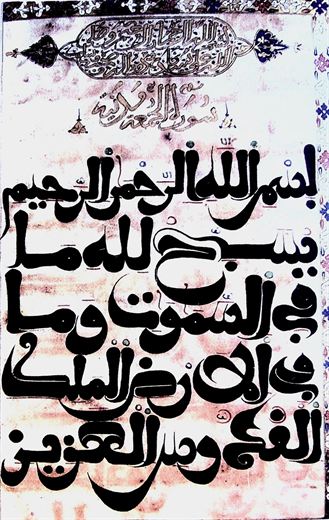
Omar Afa and Mohamed al-Maghrawi published in their book al-Khatt al-maghribi: tarikh wa-waqiʿ wa-afaq two pages of a Qur’an in al-Qandusi’s hand: the start of ḥizb 21 (al-Tawba 93) and the start of ḥizb 56 (the opening of Surat al-Jumuʿa), each topped by a gilded band with the basmala and the blessing on the Prophet, as volumes open. These two ḥizbs open volumes 5 and 12 of a rabʿa with five ḥizbs to the volume, which matches al-ʿAmrawi’s rabʿa, so they most likely come from it.

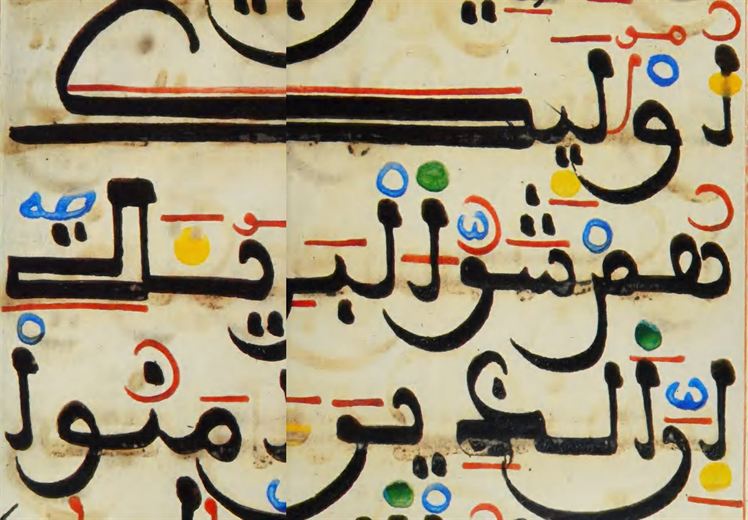
Mohamed Sijelmassi published in his book on the manuscripts of the Royal Library (1987) a detail of a “noble Qur’an” in al-Qandusi’s hand kept there as no. 12613 (al-Bayyina 6–7). We found nothing to show that the Royal Library manuscript is this same rabʿa, passed there from the Zaydaniyya.

Not digitised for the public, as far as we know.

On the edge of the criteria 2

4

The Qur’an of Amina bint al-Hajj ʿAbd al-Latif

c. 1227 AH · 1812 CE
In the reign of Mawlay Sulayman
Page of this Qur’an →
SurvivesCompleteness unknownNot digitised
Copyist
Amina bint al-Hajj ʿAbd al-Latif, a jurist and copyist of Tetouan, who learned jurisprudence and the craft of copying from her father
Place
Tetouan
Today
We have not found where it is

David James wrote her entry in the Dictionary of African Biography (2011), noting that among her copies there survive a fragment of al-Targhib wa-l-tarhib dated 1802 CE and a Qur’an dated 1812 CE.

We have not seen the Qur’an itself, the text of its colophon, or where it is today.

5

The first Qur’an lithographed in Fez

1296 AH · 1878–1879 CE
In the reign of al-Hasan I
Page of this Qur’an →
SurvivesCompleteNot digitised
Printer
The press of al-Hajj al-Tayyib b. Muhammad al-Azraq of Fez
Place
Fez

The first Qur’an printed in Morocco, some fifteen years after lithography reached Fez. Lithography reproduces the copyist’s own hand, so a Qur’an printed this way is an image of a manuscript, which is why Moroccans preferred it to movable type.

Printed, not manuscript, and we have not found the name of the copyist whose hand it reproduces.

Recorded in the sources, now lost 3

Before 1142 AH

The Qur’ans of the sharīfa Fatima bint ʿAli al-Zabadi

before 1730 CE
Lost

A woman of Fez, sister of the shaykh ʿAbd al-Majid al-Zabadi, who died in 1142 AH / 1730 CE and copied more than thirty-five Qur’ans in her own hand. We have found none of them whose whereabouts is known.

Source: Al-Manuni (1968), from the sources of her biography
Page of this Qur’an →
1155 AH

The twenty-three Qur’ans Mawlay ʿAbd Allah sent to the Prophet’s Mosque

1742–1743 CE
Lost

Al-Zayyani records among the events of 1155 AH that Sultan Mawlay ʿAbd Allah b. Ismaʿil sent with the pilgrim caravan twenty-three Qur’ans, “large and small, all adorned with gold and set with pearls and rubies”, among them “the great ʿUqbani Qur’an” attributed to ʿUqba b. Nafiʿ, which the kings had handed down. We have found none of them whose whereabouts is known today.

Source: Al-Zayyani, al-Bustan al-zarif, cited by al-Manuni (1968)
Page of this Qur’an →
Before 1313 AH

The Qur’ans of Muhammad b. al-Hajj Muhammad al-Rifi al-Tamsamani

before 1896 CE
Lost

A calligrapher from the Rif who settled in Essaouira and died in Tangier in 1313 AH / 1895–1896 CE. He wrote Qur’ans in a minute script on thin paper, in a format small enough to fit inside the hand. We have found none of them whose whereabouts is known.

Source: Al-Manuni (1968)
Page of this Qur’an →
Sources

References and image rights

Every statement on the cards comes from one of these sources.

  • Mohamed Abdelhafid Khabta, al-Khatt al-maghribi wa-asnafuhu fi l-masahif al-makhtuta (Maghribi script and its varieties in manuscript Qur’ans, doctoral thesis, 2010–2011): the Dar al-Kutub Qur’an 25 (figs 13c and 202a).
  • Mohammed al-Manuni, “Markaz al-mushaf al-sharif bi-l-Maghrib” (The place of the Qur’an in Morocco), Daʿwat al-Haqq 105 (1968): the Qur’an of Prince ʿAli, the rabʿa of al-Qandusi, the Qur’ans of ʿAʾisha al-Takiyya, the Qur’ans of Fatima al-Zabadi and al-Tamsamani, Mawlay ʿAbd Allah’s gift to Medina, and the Fez lithographed Qur’an.
  • Catalogue of the Egyptian National Library (Dar al-Kutub), vol. 1, p. 2: the Qur’an of Prince ʿAli (cited by al-Manuni).
  • Muhammad b. Jaʿfar al-Kattani, Salwat al-anfas: the biography of al-Qandusi (cited by al-Manuni).
  • Abu al-Qasim al-Zayyani, al-Bustan al-zarif: the events of 1155 AH (cited by al-Manuni).
  • Mohammed al-Manuni, “al-Tibaʿa al-hajariyya al-fasiyya” (Fez lithography), Tetouan 10, p. 147.
  • David James, “Amina bint al-Hajj ʿAbd al-Latif”, in Dictionary of African Biography, Oxford University Press, 2011.

Limits of this guide

We relied mainly on Mohammed al-Manuni’s article “Markaz al-mushaf al-sharif bi-l-Maghrib” (1968). The Royal Library, the National Library, the Qarawiyyin Library and the libraries of the zawiyas hold many dated Alaouite Qur’ans, most of them with no published catalogue and no digitised copy. Western libraries hold Qur’ans in Maghribi script dated to this period that name neither copyist nor place, such as a volume in the Bavarian State Library dated 1273 AH (Cod.arab. 2850) and a small Qur’an at Princeton University dated Rabiʿ I 1212 AH (Garrett 50G); we did not include them.

Images: the two pages of Prince ʿAli’s Qur’an after the thesis of Mohamed Abdelhafid Khabta (fig. 13c); the two pages of al-Qandusi’s Qur’an after Omar Afa and Mohamed al-Maghrawi, al-Khatt al-maghribi: tarikh wa-waqiʿ wa-afaq (Maghribi script: history, present and prospects), via Wikimedia Commons (public domain); and the third detail after Mohamed Sijelmassi, Enluminures des manuscrits royaux au Maroc (Paris, ACR Édition, 1987), pp. 204–205. Some images are reproduced from published studies, mostly at low resolution, to introduce Qur’ans that have not been digitised; the source of each image is given under it, and the rights belong to their owners and to the libraries that hold the manuscripts. Weak images were enhanced with AI (Real-ESRGAN, blended with a plain enlargement so that the letter forms do not change), and each enhanced image is marked under it.