An illustrated guide · 172–375 AH / 788–985 CE

Idrisid Qur’ans

Dated Qur’ans with a known copyist or patron from the Idrisid period: the ones that have come down to us, and the ones that can be browsed online today.

No dated Qur’an from the Idrisid period is known today, nor one that names its copyist or owner. In these centuries Qur’ans were written in the early Abbasid scripts on horizontal parchment, and their colophons rarely gave a date or a name. When Idris II founded Fez he prayed: “I only wished in building it that You be worshipped in it and Your Book be recited in it.” This page presents what may go back to this period, and the limits of that attribution.

Browse the Qur’ans Overview table
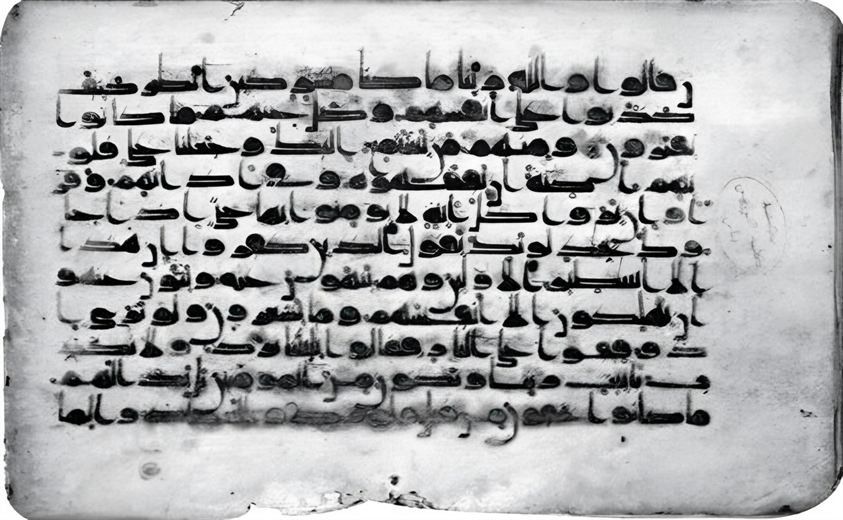
Lines from the Qur’an fragment Qarawiyyin 902
Lines in early Abbasid script from a Qur’an fragment on parchment in the Qarawiyyin Library (Mushaf 902), thought to date from the fourth century AH. After Bongianino 2017; AI-enhanced image.
Overview

What do we know?

This guide lists 1 Qur’an in three groups: those that survive and meet the criteria, those recorded in the sources and since lost, and those on the edge of the criteria.

0
surviving Qur’ans meeting the criteria
0
Qur’ans recorded in the sources, with no known trace today
1
Qur’an on the edge of the criteria, included for comparison
0
Qur’ans whose surviving parts can be browsed in full at the source

Criteria

A Qur’an enters the first list when three things hold:

  • The date of copying is stated explicitly in its colophon or endowment deed, not inferred from its style.
  • Its owner is known: the copyist, if named, or the person for whom or for whose library it was made.
  • It was demonstrably copied in the Idrisid lands of the far Maghrib.

The Idrisids ruled northern Morocco from 172 AH / 788 CE, and Idris II founded Fez. In the fourth century AH their realm shrank between the Fatimids and the Umayyads of al-Andalus, until it ended in 375 AH / 985 CE.

What the badges mean

Each card carries three badges: does the Qur’an survive? Is it complete? Can it be browsed online?

SurvivesLostCompleteIncompleteFully digitisedPartial imagesNot digitisedUnknown
SampleQur’anDateStateCompletenessDigitisationWhere todayBrowse
On the edge of the criteria
The Qarawiyyin Qur’an 902More about it → Fourth century AH (estimated)
tenth century CE
Survives Incomplete Not digitised Fez —
Timeline

Qur’ans in the reigns of the emirs

The bars are the reigns of the main rulers and the markers are the Qur’ans. A filled marker is a surviving Qur’an, a hollow one a lost Qur’an, and a horizontal line the span within which an undated Qur’an falls.

780800820840860880900920940960980Idris IIdris IISons and grandsons of Idris IIBetween Fatimids and UmayyadsA Qur’an fragment in early Abbasid script in the Qarawiyyin Library — Fourth century AH (estimated)Qarawiyyin 902edge
Click a marker to jump to its card. On a phone, swipe the timeline sideways.
The Qur’ans

Cards and samples

The samples are close-ups of the writing itself, not of the illumination or the opening pages. Click a sample to enlarge it; you can zoom and pan, and follow a link to the full page at the library that holds the manuscript.

On the edge of the criteria 1

1

A Qur’an fragment in early Abbasid script in the Qarawiyyin Library

Fourth century AH (estimated) · tenth century CE
Page of this Qur’an →
SurvivesIncompleteNot digitised
Today
Fez, Qarawiyyin Library, Mushaf no. 902
Format
12 parchment folios; 25 × 28 cm, horizontal format; 11 lines
Script
“Group D” in François Déroche’s classification of the early Abbasid scripts
Origin
al-Andalus or the Maghrib, according to the catalogue of the exhibition Masahif al-Maghrib (2011)

One of the horizontal-format Qur’an fragments in early Abbasid script. The Qarawiyyin Library holds the most important group of them in Morocco, including near-complete copies that have not yet been studied. Umberto Bongianino published an image of one of its leaves (fol. 6r).

Undated; its copyist and place of copying are not known for certain, and its dating to the fourth century AH is an estimate, so it may be later than the Idrisids.

Sources

References and image rights

Every statement on the cards comes from one of these sources.

  • Umberto Bongianino, “Quelques remarques sur l’origine des écritures coraniques arrondies en al-Andalus (Ve/XIe–VIe/XIIe siècles)”, Al-Qanṭara 38/2 (2017), 153–187: the Qarawiyyin 902 Qur’an and the Qarawiyyin Qur’ans in early Abbasid script.
  • Catalogue of the exhibition Masahif al-Maghrib, Rabat, 2011 (cited by Bongianino).
  • Umberto Bongianino, “A Rediscovered Almoravid Qurʾān in the Bavarian State Library, Munich (Cod. arab. 4)”, Journal of Islamic Manuscripts 11/3 (2020), appendix: the oldest dated Maghribi Qur’ans (398 and 432 AH).
  • Mohammed al-Manuni, “Markaz al-mushaf al-sharif bi-l-Maghrib” (The place of the Qur’an in Morocco), Daʿwat al-Haqq 105 (1968): the prayer of Idris II, and the Qur’an of ʿUqba.

Limits of this guide

We found no dated Qur’an, or Qur’an with a known copyist, from the Idrisid period in the published studies. The oldest known dated Maghribi Qur’ans are two leaves in the Museum of Turkish and Islamic Arts in Istanbul, dated Rajab 398 AH and Safar 432 AH; both are later than the fall of the Idrisids and their place of copying is unknown. The “Qur’an of ʿUqba b. Nafiʿ” mentioned in Moroccan sources is attributed to the time of the conquest, not to the Idrisids; Mawlay ʿAbd Allah the Alaouite sent it as a gift to Medina in 1155 AH. The Qarawiyyin Library holds fragments and near-complete Qur’ans in early Abbasid scripts that have not yet been studied, and some of them may go back to this period.

Images: a page of the Qarawiyyin 902 fragment, after Umberto Bongianino’s article in Al-Qanṭara (2017), fig. 1. Some images are reproduced from published studies, mostly at low resolution, to introduce Qur’ans that have not been digitised; the source of each image is given under it, and the rights belong to their owners and to the libraries that hold the manuscripts. Weak images were enhanced with AI (Real-ESRGAN, blended with a plain enlargement so that the letter forms do not change), and each enhanced image is marked under it.