An illustrated guide · 916–1069 AH / 1510–1659 CE

Saadian Qur’ans

Dated Qur’ans with a known copyist or patron from the Saadian period: the ones that have come down to us, and the ones that can be browsed online today.

The best-known surviving Saadian Qur’ans are in the Escorial, where they have been since the Spanish seized the library of Sultan Zaydan in 1612 CE. In this period the old Almohad Qur’ans were restored in Marrakesh and put back into use. Five Qur’ans meet the criteria here: four written for the libraries of the sultan’s family, namely the Qur’an of Princess Maryam (967 AH), of Prince Muhammad b. ʿAbd al-Qadir (968 AH), of Sultan ʿAbd Allah al-Ghalib (975 AH) and of Sultan Ahmad al-Mansur (1008 AH), and a fifth written by the bookbinder Ahmad al-Sufyani in Fez (1025 AH). On the edge of the criteria are dated Qur’ans that lack the place or the copyist.

Browse the Qur’ans Overview table
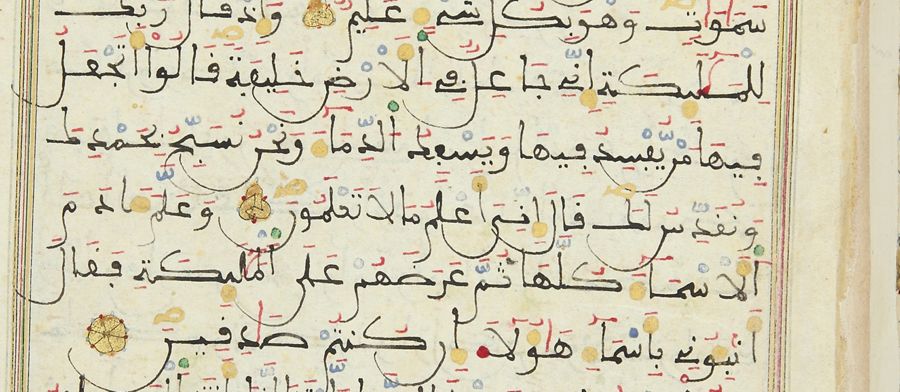
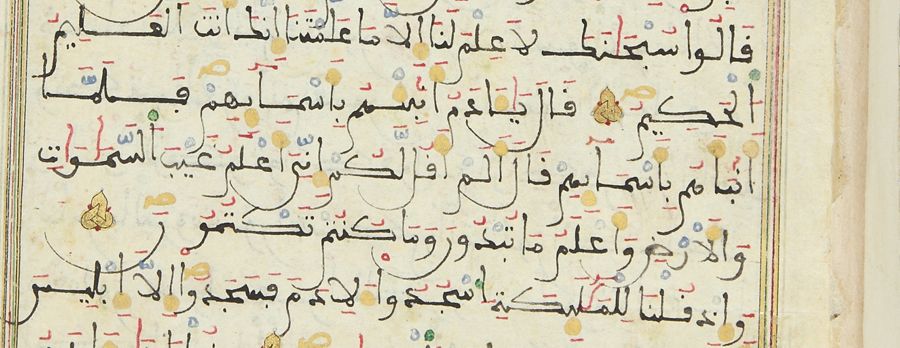
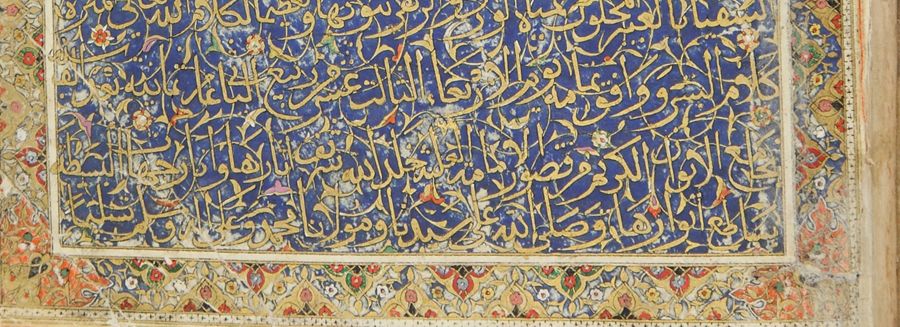
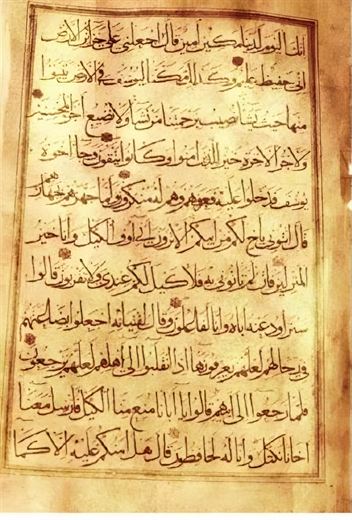
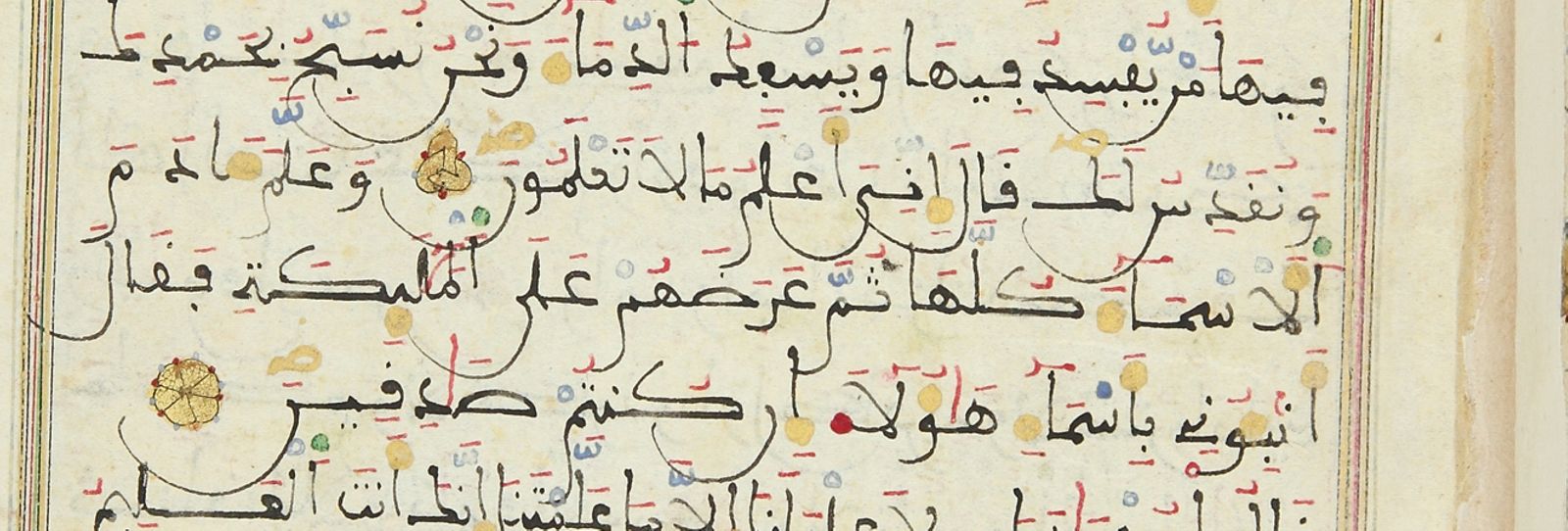
Lines from the Qur’an of the library of Ahmad al-Mansur, 1008 AH
«للملائكة إني جاعل في الأرض خليفة», “...to the angels: I am placing a vicegerent on earth”: Surat al-Baqara in the Qur’an made for the library of Sultan Ahmad al-Mansur, Marrakesh, 1008 AH / 1599 CE. Patrimonio Nacional. Real Biblioteca del Monasterio de El Escorial, Árabe 1340.
Overview

What do we know?

This guide lists 14 Qur’ans in three groups: those that survive and meet the criteria, those recorded in the sources and since lost, and those on the edge of the criteria.

5
surviving Qur’ans meeting the criteria
0
Qur’ans recorded in the sources, with no known trace today
9
Qur’ans on the edge of the criteria, included for comparison
4
Qur’ans whose surviving parts can be browsed in full at the source

Criteria

A Qur’an enters the first list when three things hold:

  • The date of copying is stated explicitly in its colophon or endowment deed, not inferred from its style.
  • Its owner is known: the copyist, if named, or the person for whom or for whose library it was made.
  • It was demonstrably copied in Morocco under the Saadians.

The Saadians rose in the Sous in 916 AH / 1510 CE, entered Marrakesh in 931 AH / 1525 CE and Fez in 961 AH / 1554 CE; their realm fragmented after the death of al-Mansur in 1012 AH / 1603 CE.

What the badges mean

Each card carries three badges: does the Qur’an survive? Is it complete? Can it be browsed online?

SurvivesLostCompleteIncompleteFully digitisedPartial imagesNot digitisedUnknown
SampleQur’anDateStateCompletenessDigitisationWhere todayBrowse
Surviving, meeting the criteria
Princess Maryam’s Qur’an (Rabat)More about it → 1 Shaʿban 967 AH
c. 27 April 1560 CE
Survives Completeness unknown Not digitised Rabat —
Prince Muhammad’s Qur’an (Rabat)More about it → Early Ramadan 968 AH
c. May 1561 CE
Survives Completeness unknown Not digitised Rabat —
Al-Ghalib’s Qur’an (London)More about it → Early Ramadan 975 AH
c. 28 February – early March 1568 CE
Survives Incomplete Not digitised London —
Al-Mansur’s Qur’an (Escorial)More about it → Wednesday 13 Rabiʿ II 1008 AH
c. 2 November 1599 CE
Survives Complete Fully digitised El Escorial Open ↗
Al-Sufyani’s Qur’an (Fez)More about it → 1025 AH
1616 CE
Survives Completeness unknown Not digitised Fez —
On the edge of the criteria
—The Qur’an of 966 AHMore about it → 966 AH
1558–1559 CE
Lost — — Unknown —
Ibn ʿIsa’s Qur’an (Tunis)More about it → 982 AH
1574–1575 CE
Survives Completeness unknown Not digitised Tunis —
The Qarawiyyin Qur’an 5More about it → Before 1020 AH
before 1611 CE
Survives Completeness unknown Not digitised Fez —
The Great Qur’an (Fez)More about it → Endowed in Ramadan 1011 AH
February 1603 CE
Survives Completeness unknown Not digitised Fez —
—Ibn Husayn’s two Qur’ans (Escorial)More about it → Safar 1015 AH and Rabiʿ II 1016 AH
1606 CE and 1607 CE
Survives Complete Not digitised El Escorial —
—Al-Hasani’s Qur’an (Escorial)More about it → Shaʿban 1028 AH
July–August 1619 CE
Survives Complete Not digitised El Escorial —
—The Qur’an of 1044 AH (Paris)More about it → 1044 AH
1634–1635 CE
Survives Completeness unknown Fully digitised Paris Open ↗
The captive’s Qur’an (Philadelphia)More about it → Thursday 16 Muharram 1065 AH
26 November 1654 CE
Survives Incomplete Fully digitised Philadelphia Open ↗
—Al-Darʿi’s Qur’an (Paris)More about it → 3 Dhu l-Qaʿda 1069 AH
23 July 1659 CE
Survives Incomplete Fully digitised Paris Open ↗
Timeline

Qur’ans in the reigns of the sultans

The bars are the reigns of the main rulers and the markers are the Qur’ans. A filled marker is a surviving Qur’an, a hollow one a lost Qur’an, and a horizontal line the span within which an undated Qur’an falls.

15201540156015801600162016401660al-Qaʾim bi-Amr AllahAhmad al-AʿrajMuhammad al-ShaykhʿAbd Allah al-Ghalibal-Mutawakkil and ʿAbd al-MalikAhmad al-MansurZaydan and his brothersThe last SaadiansA Saadian Qur’an dated 966 AH — 966 AHQur’an of 966The Qur’an made for the library of Princess Maryam, daughter of Muhammad al-Shaykh — 1 Shaʿban 967 AHPrincess Maryam 967The Qur’an made for the library of Prince Muhammad b. ʿAbd al-Qadir — Early Ramadan 968 AHPrince Muhammad 968The Qur’an made for the library of Sultan ʿAbd Allah al-Ghalib — Early Ramadan 975 AHal-Ghalib 975The Qur’an of Muhammad b. ʿAbd al-Rahman b. ʿIsa on parchment — 982 AHIbn ʿIsa 982The Qur’an made for the library of Sultan Ahmad al-Mansur — Wednesday 13 Rabiʿ II 1008 AHal-Mansur 1008The Qarawiyyin Qur’an no. 5 — Before 1020 AHQarawiyyin 5“The Great Qur’an” endowed by al-Mansur to the Qarawiyyin — Endowed in Ramadan 1011 AHGreat Qur’anThe two Qur’ans of Ahmad b. Muhammad b. Husayn — Safar 1015 AH and Rabiʿ II 1016 AHIbn Husayn 1015–1016The Qur’an of Abu al-ʿAbbas Ahmad b. Muhammad al-Sufyani — 1025 AHal-Sufyani 1025The Qur’an of Muhammad b. Ahmad al-Sharif al-Hasani — Shaʿban 1028 AHal-Hasani 1028A Saadian Qur’an dated 1044 AH — 1044 AHParis 1044The Qur’an of the captive Muhammad b. ʿAbd al-Wahid al-Tazi — Thursday 16 Muharram 1065 AHMalta 1065The second half of a Qur’an in the hand of Saʿid b. ʿAli al-Darʿi — 3 Dhu l-Qaʿda 1069 AHal-Darʿi 1069survivingedge
Click a marker to jump to its card. On a phone, swipe the timeline sideways.
The Qur’ans

Cards and samples

The samples are close-ups of the writing itself, not of the illumination or the opening pages. Click a sample to enlarge it; you can zoom and pan, and follow a link to the full page at the library that holds the manuscript.

Surviving, meeting the criteria 5

1

The Qur’an made for the library of Princess Maryam, daughter of Muhammad al-Shaykh

1 Shaʿban 967 AH · c. 27 April 1560 CE
In the reign of ʿAbd Allah al-Ghalib
Page of this Qur’an →
SurvivesCompleteness unknownNot digitised
Owner
Written «برسم خزانة», “for the library” of Princess Maryam, daughter of the Saadian Sultan Muhammad al-Shaykh and sister of ʿAbd Allah al-Ghalib
Copyist
Not named
Today
Rabat, National Library, J 656
Format
Stiff brown paper, with the first and last pages of parchment; 17 lines; modern binding

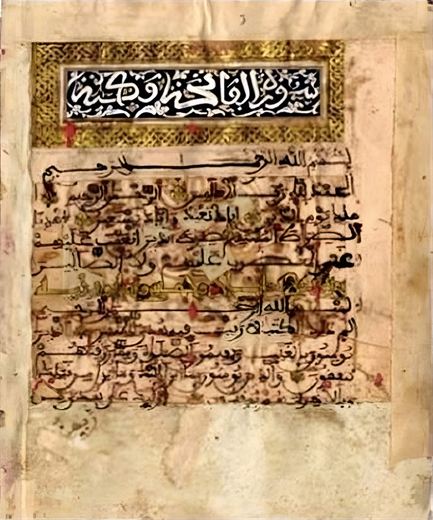
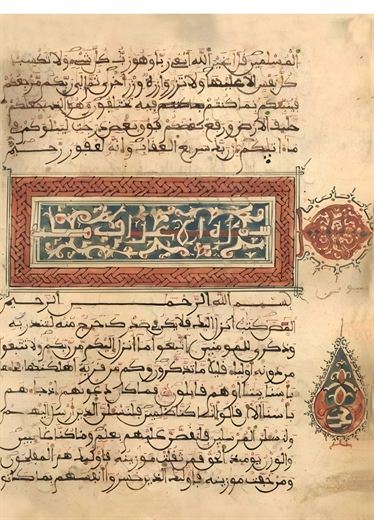
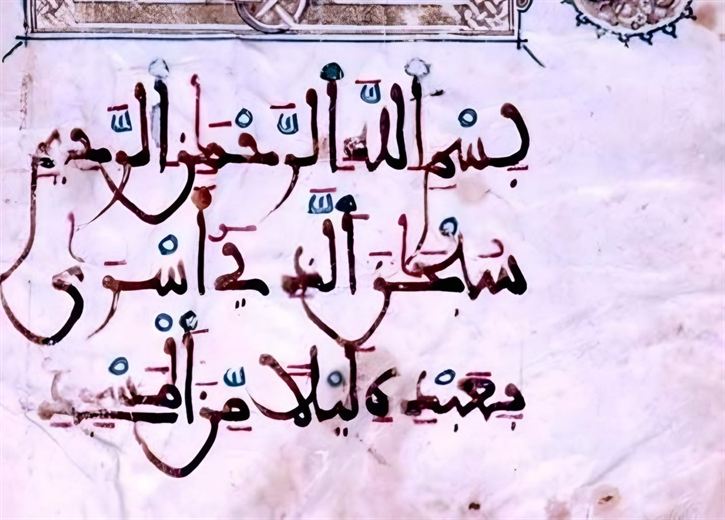
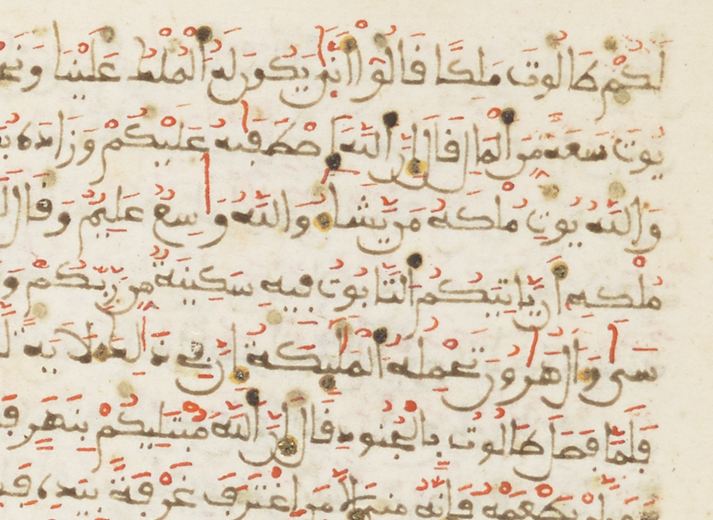
The oldest dated Saadian Qur’an with a known owner that we have found. Its script is a fine Maghribi hand leaning towards mabsūṭ; the vowels are in red, shadda and sukūn sometimes in blue and sometimes in green, the hamza in yellow, and al-Habti’s pausal marks in bright green. The verse separators are gilded rosettes of different shapes for single verses, fifths and tenths.

At the end is a colophon in gold on lapis blue in six lines within a gilded frame, and two gilded pages. Mohamed Abdelhafid Khabta finds its decoration closest among Saadian Qur’ans to that of her brother ʿAbd Allah al-Ghalib’s Qur’an.

The sources available to us do not give its place of copying, and it is not digitised. Khabta published images of it.

2

The Qur’an made for the library of Prince Muhammad b. ʿAbd al-Qadir

Early Ramadan 968 AH · c. May 1561 CE
In the reign of ʿAbd Allah al-Ghalib
Page of this Qur’an →
SurvivesCompleteness unknownNot digitised
Owner
Prince Muhammad b. ʿAbd al-Qadir, grandson of Sultan Muhammad al-Shaykh, vizier of his uncle ʿAbd Allah al-Ghalib and his governor in Meknes, whom his uncle had killed in 975 AH
Copyist
Not named
Today
Rabat, National Library, J 606
Format
Brown paper; vowels in red, shadda and sukūn in blue, hamza in yellow, waṣla in green, and al-Habti’s pausal marks in red

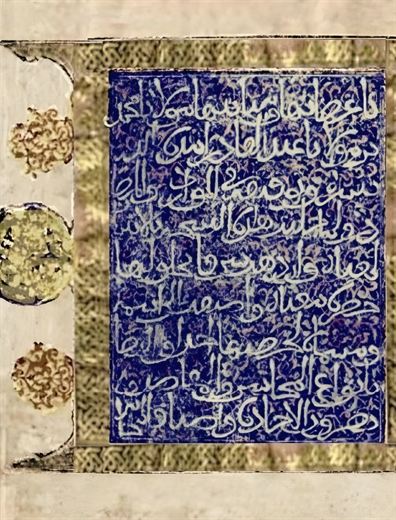
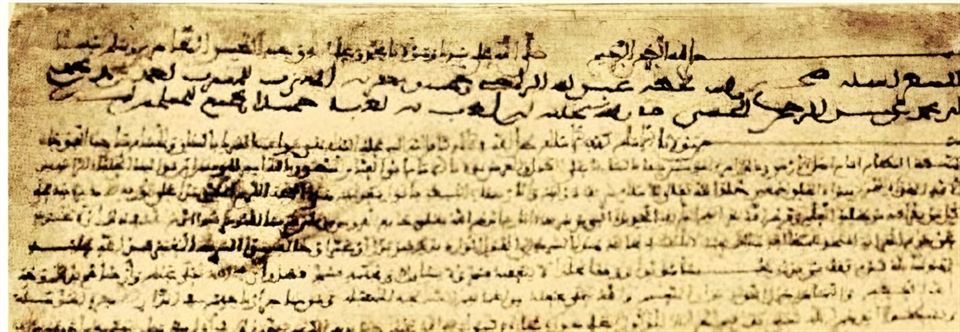
Its colophon is one of the longest in Maghribi Qur’ans: five pages of Maghribi thuluth on a decorated blue ground within gilded frames. It is a rhymed text in praise of the prince, ending with two verses spoken by the Qur’an itself: «أيا ناظراً رقمي وحسن صنائعي، ومستنشقاً عرفي وأذكى بدائعي، لك الله فادعُ للمعلّم إنه إمامٌ له دانت جميع الصنائعِ», “O you who look upon my script and my fine craftsmanship, and breathe my fragrance and my finest wonders: God be with you; pray for the master, for he is an imam to whom all the crafts have bowed.” Then: «وكان الفراغ منها أوائل رمضان... وتسعمائة», “it was finished in early Ramadan... and nine hundred”.

The colophon, as far as it has been published, does not give the place of copying, and the Qur’an is not digitised. Mohammed al-Manuni published the colophon in 1969, and Khabta later reconstructed it in colour from a black-and-white image.

3

The Qur’an made for the library of Sultan ʿAbd Allah al-Ghalib

Early Ramadan 975 AH · c. 28 February – early March 1568 CE
In the reign of ʿAbd Allah al-Ghalib
Page of this Qur’an →
SurvivesIncompleteNot digitised
Owner
Written for our lord Abu Muhammad ʿAbd Allah, son of the Commander of the Muslims Abu ʿAbd Allah Muhammad al-Shaykh al-Sharif, that is, Sultan ʿAbd Allah al-Ghalib (r. 964–981 AH / 1557–1574 CE)
Copyist
We did not find his name in the catalogue description
Place
Not given in the catalogue description; the Qur’an was written for the sultan’s own library
Today
London, British Library, Or. 1405
Format
400 folios; about 26 × 20 cm; 17 lines; a large, clear Maghribi script; leaves alternating in colour between beige, yellow and pink

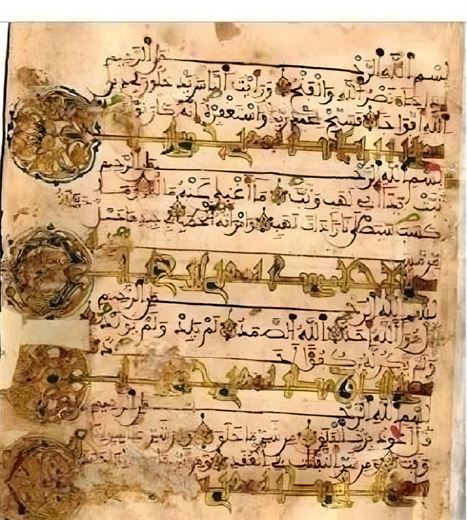
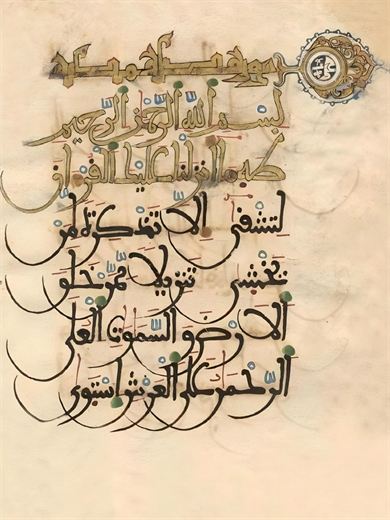
A luxury Qur’an, vocalised with red for the vowels, yellow for the hamza and green for the waṣla, shadda and sukūn. Its margins mark every division of the Qur’an, from halves, thirds and quarters down to tenths, the sixty ḥizbs, and twenty-seven sections for the nights of Ramadan. The sura headings are in gilded Kufic.

Its colophon, in an ornamental white script on a blue ground, runs over four pages (397v–399r), followed by two pages of geometric decoration in gold and colours. The first twelve leaves are modern replacements for those lost at the beginning.

We found no published digitised copy. It is described in Rieu’s catalogue of the supplement of Arabic manuscripts in the British Museum (1894), and Bongianino and Cellard drew attention to its pink leaves.

4

The Qur’an made for the library of Sultan Ahmad al-Mansur

Wednesday 13 Rabiʿ II 1008 AH · c. 2 November 1599 CE
In the reign of Ahmad al-Mansur
Page of this Qur’an →
SurvivesCompleteFully digitised
Owner
Written «برسم الخزانة العلية الكريمة النبوية الحسنية الإمامية الأحمدية المنصورية», “for the exalted, noble, prophetic, Hasanid, imamic, Ahmadi, Mansuri library”, that is, the library of Sultan Ahmad al-Mansur al-Dhahabi (r. 986–1012 AH / 1578–1603 CE)
Copyist
We did not find his name in the colophon
Place
«بجامع الديوان الكريم من قصور الإمامة العلية», “in the mosque of the noble Diwan in the palaces of the exalted imamate”, in Marrakesh
Today
El Escorial, Royal Library, árabe 1340
Format
Paper; 266 folios; 263 × 177 mm; 17 lines
Reading
Qalun from Nafiʿ

It is known as the Qur’an of Mawlay Zaydan, because it was in the library of al-Mansur’s son, Sultan Zaydan, when the Spanish seized it in 1612 CE, and entered the Escorial with the rest of his books.

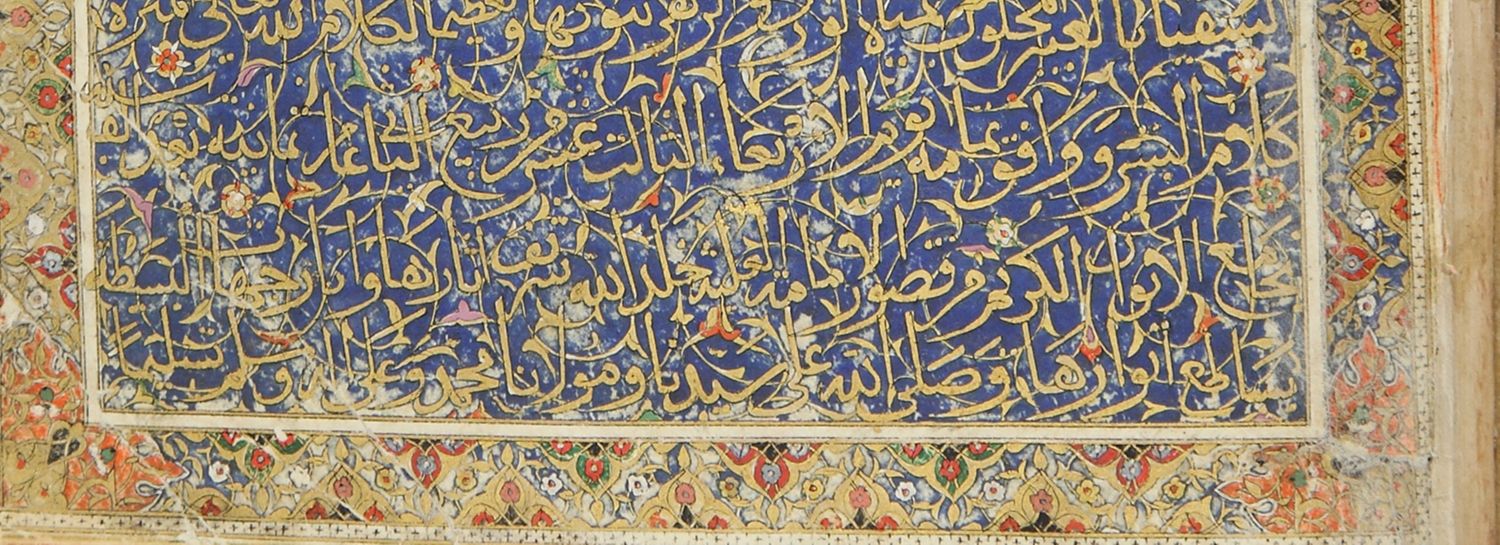
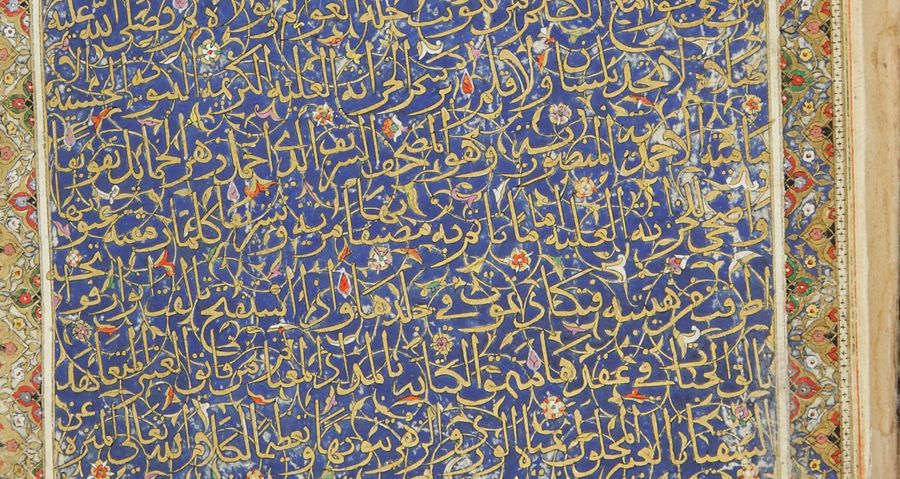
Its colophon is a full page in gold on a lapis blue ground, and describes the ink: «بالمداد المقام من فائق العنبر المتعاهد السقيا بالعبير...», “with ink made of the finest ambergris, steeped again and again in perfume...”. François Déroche and Nuria Martínez de Castilla see a clear Ottoman influence in its binding and decoration. Between its lines, small gold ṣāds mark the places of pause set out by Muhammad al-Habti (d. 930 AH).

The colophon: date and place

From the colophon in gold on lapis blue (fol. 264r)

...برسم الخزانة العلية الكريمة النبوية الحسنية الإمامية الأحمدية المنصورية... ووافق تمامه يوم الأربعاء الثالث عشر من ربيع الثاني عام ثمانية وألف بجامع الديوان الكريم من قصور الإمامة العلية...

...for the exalted, noble, prophetic, Hasanid, imamic, Ahmadi, Mansuri library... Its completion fell on Wednesday the thirteenth of Rabiʿ II of the year one thousand and eight, in the mosque of the noble Diwan in the palaces of the exalted imamate...

Our reading from the image of the folio. The text is long, so we have kept only the passages naming the library and the date. 13 Rabiʿ II 1008 AH corresponds to about 2 November 1599 CE.

From Marrakesh to the Escorial

1008 AH / 1599 CEWritten for the library of Ahmad al-Mansur in Marrakesh
1012 AH / 1603 CEAl-Mansur died, and the Qur’an passed to his son Zaydan
1612 CEThe Spanish seized Zaydan’s library
Since 1612 CEIn the Royal Library of the monastery of El Escorial
5

The Qur’an of Abu al-ʿAbbas Ahmad b. Muhammad al-Sufyani

1025 AH · 1616 CE
In the reign of Zaydan and his brothers
Page of this Qur’an →
SurvivesCompleteness unknownNot digitised
Copyist
Abu al-ʿAbbas Ahmad b. Muhammad al-Sufyani, the bookbinder of Fez, who wrote it in his own hand
Place
Fez
Today
Fez, Qarawiyyin Library, no. 3
Vocalisation
Vowels in red only, hamza in yellow, waṣla in green, and al-Habti’s pausal marks in the colour of the ink; sura openings in Kufic

Al-Sufyani was one of the great bookbinders of the late Saadian period. Four years after copying this Qur’an he wrote his treatise Sinaʿat tasfir al-kutub wa-hall al-dhahab (The art of bookbinding and the dissolving of gold, 1029 AH), one of the most important works on the craft of the book in Morocco. This Qur’an is thus in the hand of a man who was both copyist and binder. In it al-Sufyani departs from the custom of his time and does not use blue for shadda and sukūn.

Not digitised, and Khabta did not publish the full text of its colophon.

On the edge of the criteria 9

6

A Saadian Qur’an dated 966 AH

966 AH · 1558–1559 CE
In the reign of ʿAbd Allah al-Ghalib
Page of this Qur’an →
Lost
Last known
Owned by the French Resident-General Lyautey, then sold at auction at the Hôtel Drouot in Paris on 23 June 1975 (lot 106)

Mentioned in a note of the study of the Pink Qur’an, among the manuscripts that left Marrakesh in the early twentieth century.

Dated, but we know neither its copyist nor its present whereabouts.

7

The Qur’an of Muhammad b. ʿAbd al-Rahman b. ʿIsa on parchment

982 AH · 1574–1575 CE
In the reign of Muhammad al-Mutawakkil
Page of this Qur’an →
SurvivesCompleteness unknownNot digitised
Copyist
Muhammad b. ʿAbd al-Rahman b. ʿIsa
Today
Tunis, National Library, no. 4137
Format
Parchment

Khabta counts it as Saadian, written in the year Muhammad al-Mutawakkil came to power, and one of the few examples in which parchment was still used in the Saadian period after paper had prevailed.

The date and the copyist are known, but we do not know the place of copying, and cannot be sure that it is Moroccan rather than Tunisian.

8

The Qarawiyyin Qur’an no. 5

Before 1020 AH · before 1611 CE
Page of this Qur’an →
SurvivesCompleteness unknownNot digitised
Today
Fez, Qarawiyyin Library ms. 5, volumes 2–5 of six
Format
Coloured paper: yellow, blue, white, red and pink; the text in black, and the name of God and the sura openings in gold
Endowment
To the Qarawiyyin Library in Jumada II 1020 AH, received by its keeper Masʿud Qassara

One of the few Qur’ans written on coloured paper, pink among it. Bongianino and Cellard consider it Saadian; Mohamed Abdelhafid Khabta considers it Marinid. It was in the Saadian period that the Almohad Pink Qur’an was restored in Marrakesh, with leaves added in a hand imitating its original script.

It was copied before 1020 AH / 1611 CE, and the sources available to us give neither its exact date nor its copyist.

9

“The Great Qur’an” endowed by al-Mansur to the Qarawiyyin

Endowed in Ramadan 1011 AH · February 1603 CE
In the reign of Ahmad al-Mansur
Page of this Qur’an →
SurvivesCompleteness unknownNot digitised
Endowment
In the hand of Sultan Ahmad al-Mansur himself in Ramadan 1011 AH, at the opening of the great library of the Qarawiyyin mosque; at the top: «صحيح، وكتب بخطه عبد الله... أحمد بن محمد بن محمد بن عبد الرحمن الحسني», “Correct; written in his own hand by the servant of God... Ahmad b. Muhammad b. Muhammad b. ʿAbd al-Rahman al-Hasani”
Script
Eastern muḥaqqaq, which al-Mansur admired
Today
Fez, Qarawiyyin Library

One of the remnants of al-Mansur’s treasures that did not go with Zaydan’s library to the Escorial. ʿAbd al-Hadi al-Tazi published black-and-white images of it in his book Jamiʿ al-Qarawiyyin (1972), p. 601, and Khabta reproduced them.

It is the endowment that is dated, not the copying; the copyist is unknown, and its script is eastern, not Maghribi.

10

The two Qur’ans of Ahmad b. Muhammad b. Husayn

Safar 1015 AH and Rabiʿ II 1016 AH · 1606 CE and 1607 CE
In the reign of Zaydan and his brothers
Page of this Qur’an →
SurvivesCompleteNot digitised
Copyist
Ahmad b. Muhammad b. Husayn, who copied both
Dates
A Wednesday in Safar 1015 AH (árabe 1873); and a Friday in the last ten days of Rabiʿ II 1016 AH, about 17 August 1607 CE (árabe 1257)
Today
El Escorial, Royal Library, árabe 1257 and árabe 1873
Format
Paper; 183 and 182 folios

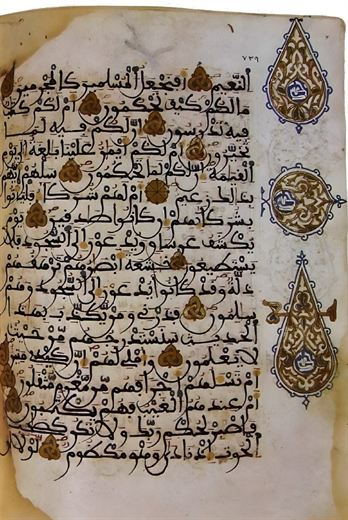
The two are close in script and page layout, and each has more than fifty different designs for the ḥizb and prostration ornaments, in many colours. They were probably copies for personal use from the circle of Sultan Zaydan.

Their origin is disputed: Déroche and Martínez de Castilla think they come from the Iberian Peninsula, while Arias Torres thinks they are Moroccan, because their markers for ḥizbs 15 and 22 follow the new Maghribi practice.

11

The Qur’an of Muhammad b. Ahmad al-Sharif al-Hasani

Shaʿban 1028 AH · July–August 1619 CE
In the reign of Zaydan and his brothers
Page of this Qur’an →
SurvivesCompleteNot digitised
Copyist
Muhammad b. Ahmad al-Sharif al-Hasani
Place
Not stated; the script and decoration are Maghribi
Today
El Escorial, Royal Library, árabe 1256
Format
Paper; a complete Qur’an; the reading of Warsh from Nafiʿ

Copied seven years after the seizure of Zaydan’s library, so it did not enter the Escorial with it; it most likely came from the library of the Count-Duke of Olivares in 1656 CE. The vowels, sukūn and shadda are in red, the waṣla in green and the hamza in orange. Its margins mark the eleven prostrations counted by the Malikis.

Its date and copyist are explicit, but the colophon does not give the place of copying.

12

A Saadian Qur’an dated 1044 AH

1044 AH · 1634–1635 CE
Page of this Qur’an →
SurvivesCompleteness unknownFully digitised
Today
Paris, Bibliothèque nationale de France, Arabe 7253 (digitised in Gallica)
Decoration
An illuminated opening in the Maghribi style that continued from the Almohads to the Alaouites

Khabta published its illuminated opening as evidence of the continuity of the Maghribi decorative style in Qur’ans from the Saadian period into the Alaouite.

Dated, but the sources available to us name neither its copyist nor its owner, nor its place of copying.

13

The Qur’an of the captive Muhammad b. ʿAbd al-Wahid al-Tazi

Thursday 16 Muharram 1065 AH · 26 November 1654 CE
Page of this Qur’an →
SurvivesIncompleteFully digitised
Copyist
Muhammad b. ʿAbd al-Wahid b. ʿAbd al-Qadir al-Tazi, “the Maghribi of Fez”, according to the colophon
Place
The island of Malta, where he was a captive of the Knights of St John
Today
Philadelphia, University of Pennsylvania, Kislak Center, Ms. Codex 1904
Format
Paper; 238 folios; 87 × 86 mm; 15 lines; the first leaf missing

A small Qur’an in Maghribi script, written by a captive from Fez in Malta, who calls himself in the colophon “the captive who confesses his sin and shortcoming”. Its sura headings are in gold on yellow, and at the end is a colophon in a red and yellow frame.

In a study of 2024, Luca Berardi argues that its copyist is Muhammad al-Tazi, captured in 1651 CE, who later converted to Christianity and became a Jesuit under the name Baldassarre Loyola Mandes (1631–1667 CE); European sources call him a prince of Fez.

Its date and copyist are explicit, but it was copied in Malta, not in the Saadian lands.

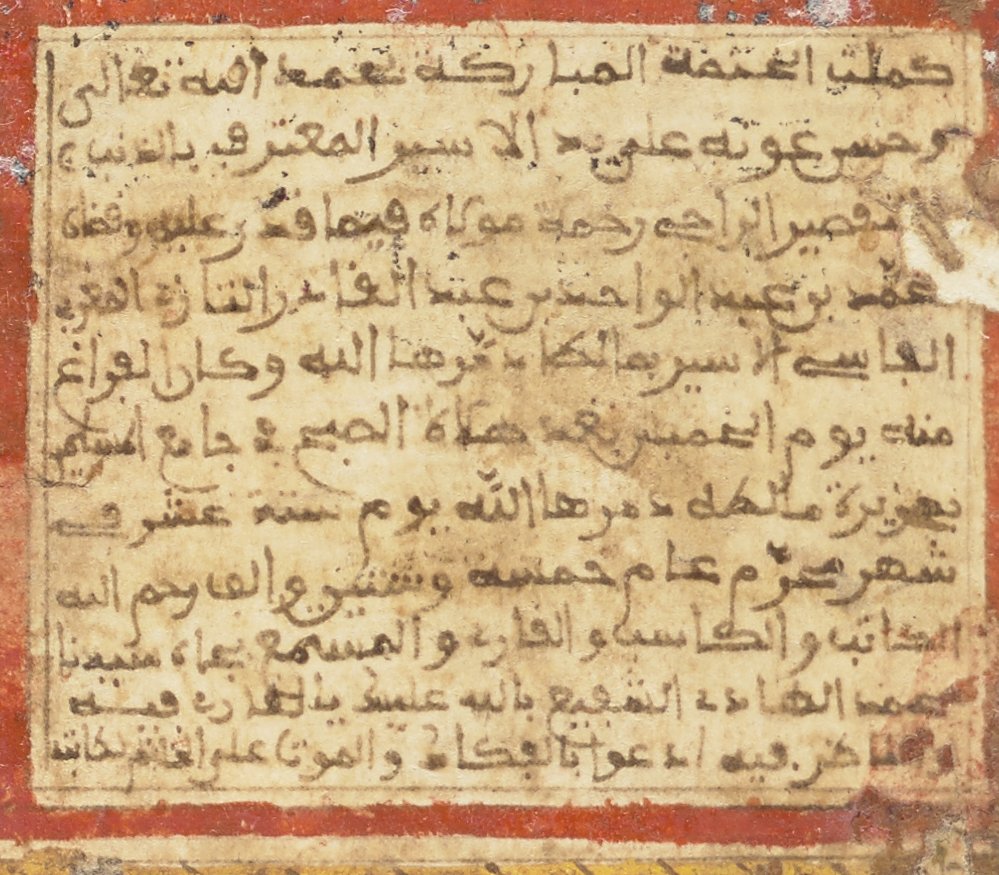
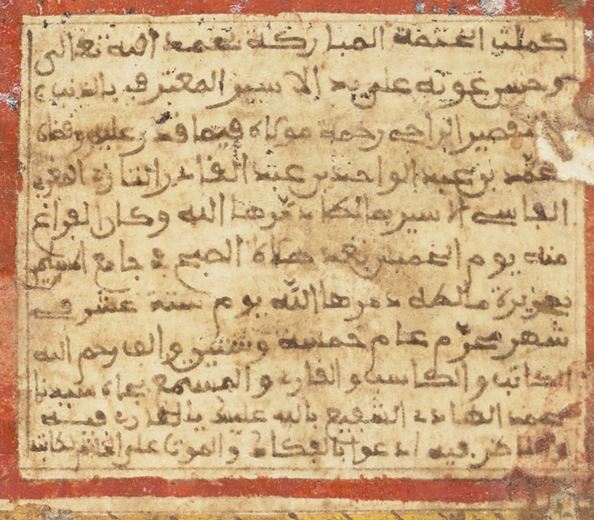
The colophon

The colophon (fol. 238r)

كملت الختمة المباركة بحمد الله تعالى وحسن عونه على يد الأسير المعترف بالذنب والتقصير، الراجي رحمة مولاه [...]، محمد بن عبد الواحد بن عبد القادر التازي المغربي الفاسي، الأسير [...] دمّرها الله. وكان الفراغ منه يوم الخميس بعد صلاة الصبح [...] بجزيرة مالطة دمّرها الله، يوم ستة عشر في شهر محرم عام خمسة وستين وألف. ورحم الله الكاتب والكاسب والقارئ والمستمع...

The blessed Qur’an was completed with the praise of God Almighty and His good aid at the hand of the captive who confesses his sin and shortcoming, hoping for the mercy of his Lord [...], Muhammad b. ʿAbd al-Wahid b. ʿAbd al-Qadir al-Tazi, the Maghribi of Fez, the captive [...], may God destroy it. It was finished on Thursday after the dawn prayer [...] on the island of Malta, may God destroy it, on the sixteenth of the month of Muharram of the year one thousand and sixty-five. May God have mercy on the writer, the buyer, the reader and the listener...

Our reading from the image; what is in square brackets is not legible in it. 16 Muharram 1065 AH corresponds to 26 November 1654 CE, as in the library’s catalogue.

14

The second half of a Qur’an in the hand of Saʿid b. ʿAli al-Darʿi

3 Dhu l-Qaʿda 1069 AH · 23 July 1659 CE
Page of this Qur’an →
SurvivesIncompleteFully digitised
Copyist
Saʿid b. ʿAli b. Zakariyya b. Masʿud b. ʿUmar, from the Draa, according to the description of the Bibliothèque nationale de France
Today
Paris, Bibliothèque nationale de France (Gallica)
Format
174 folios: prayers, then the second half of the Qur’an (Maryam – al-Nas), then prayers

Its copyist finished it before sunrise, according to the library’s description, in the year the Saadian state ended with the killing of its last sultan in Marrakesh.

Its date and copyist are explicit, but the place of copying is not stated, and the Draa was then outside Saadian rule.

Sources

References and image rights

Every statement on the cards comes from one of these sources. The reading of the colophon of al-Mansur’s Qur’an is our own, from the image of the folio.

  • Royal Library of the Monastery of El Escorial (Patrimonio Nacional), record of árabe 1340 and its IIIF manifest in RBME Digital.
  • Juan Pablo Arias Torres, “Manuscritos del Corán en la Real Biblioteca de El Escorial”, Anaquel de Estudios Árabes 36/2 (2025), 143–153: Qur’ans 1340, 1256, 1257 and 1873.
  • F. Déroche, N. Martínez de Castilla & L. Tahali, Les livres du sultan: matériaux pour une histoire du livre et de la vie intellectuelle du Maroc saadien (XVIe siècle), Peeters, 2022.
  • Umberto Bongianino & Éléonore Cellard, “The Pink Qurʾan: A Reverse Biography”, 2025: the Saadian restoration, the Qarawiyyin Qur’an 5 and the Qur’an of 966 AH.
  • Mohammed al-Manuni, “Masahif namudhajiyya bi-khutut maghribiyya” (Model Qur’ans in Maghribi scripts; website of the Ministry of Habous): the Qur’an of al-Mansur the Saadian.
  • CALLFRONT database (Institut national d’histoire de l’art, Paris), record Maghrib_UB_26.
  • Charles Rieu, Supplement to the Catalogue of the Arabic Manuscripts in the British Museum, London, 1894, no. 68: the Qur’an of al-Ghalib (Or. 1405).
  • Bibliothèque nationale de France, description of the Qur’an dated 3 Dhu l-Qaʿda 1069 AH in Gallica.
  • Mohamed Abdelhafid Khabta, al-Khatt al-maghribi wa-asnafuhu fi l-masahif al-makhtuta (Maghribi script and its varieties in manuscript Qur’ans, doctoral thesis, 2010–2011): the Qur’ans of Princess Maryam and Prince Muhammad b. ʿAbd al-Qadir, the Qur’an of al-Sufyani, the Great Qur’an, the Qur’an of Ibn ʿIsa, Arabe 7253 and the Qarawiyyin Qur’an 5.
  • Mohammed al-Manuni, “Tarikh al-mushaf al-sharif bi-l-Maghrib” (History of the Qur’an in Morocco), Majallat Maʿhad al-Makhtutat al-ʿArabiyya 15/1 (1969), pp. 45–49: the colophon of the Qur’an of Prince Muhammad b. ʿAbd al-Qadir.
  • Luca Berardi, “Copying Islamic Manuscripts in Captivity: The Case of the Qurʾan of Muḥammad al-Tāzī / Baldassarre Loyola Mandes (1631–1667)”, Manuscript Studies, 2024; and the description of Ms. Codex 1904 in OPenn (University of Pennsylvania).

Limits of this guide

We relied on what has been published and could be consulted. The Royal Library (al-Khizana al-Hasaniyya) in Rabat and the Qarawiyyin Library most likely hold dated Saadian Qur’ans that have neither a published catalogue nor a digitised copy. The book Les livres du sultan (2022) includes a catalogue of the dated Saadian manuscripts in the Escorial, whose full text we could not reach.

Images: “Patrimonio Nacional. Real Biblioteca del Monasterio de El Escorial, Árabe 1340”. The samples are displayed directly from the IIIF server of the Escorial digital library, unaltered, within the limits of its terms of use (less than 20% of the manuscript, with the source and link given). The two images of the captive’s Qur’an are from the University of Pennsylvania (OPenn, Ms. Codex 1904) and are in the public domain (Public Domain Mark). Some images are reproduced from published studies, mostly at low resolution, to introduce Qur’ans that have not been digitised; the source of each image is given under it, and the rights belong to their owners and to the libraries that hold the manuscripts. Weak images were enhanced with AI (Real-ESRGAN, blended with a plain enlargement so that the letter forms do not change), and each enhanced image is marked under it.