An illustrated guide · 876–961 AH / 1472–1554 CE

Wattasid Qur’ans

Dated Qur’ans with a known copyist or patron from the Wattasid period in Fez: the ones that have come down to us, and the ones that can be browsed online today.

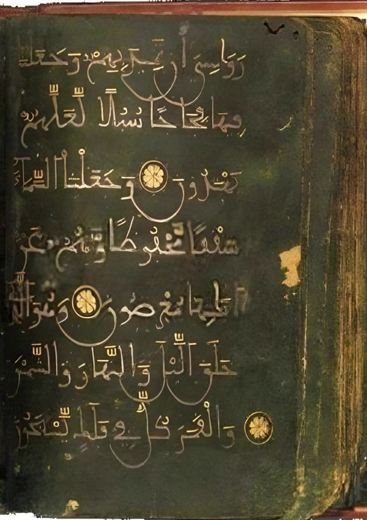
The Wattasid period is one of the poorest in studied Qur’ans: in the published studies available to us we found no Qur’an of this period that names its copyist, its date and its place together. Yet it was in this period that Muhammad b. Abi Jumʿa al-Habti (d. 930 AH in Fez) set out the pausal marks that Maghribi Qur’ans have followed to this day. The most notable survival is the Green Qur’an in the National Library in Rabat, which is undated. This page presents what we found and shows where others may be hoped for.

Browse the Qur’ans Overview table
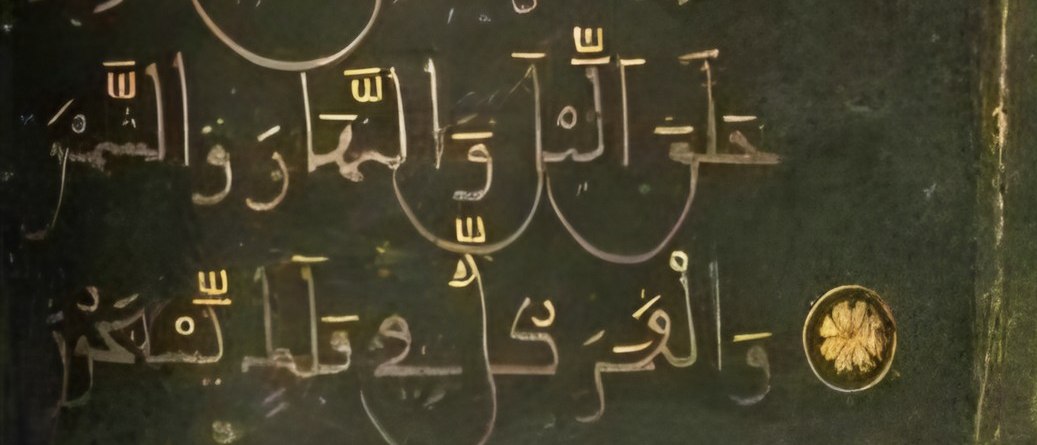
“Khalaqa l-layla wa-l-nahāra wa-l-shamsa wa-l-qamar” from the Green Qur’an
«خلق الليل والنهار والشمس والقمر كل في فلك يسبحون», “He created the night and the day, the sun and the moon, each floating in an orbit”: al-Anbiyaʾ 33 in the Green Qur’an, metallic writing on paper dyed green. National Library, Rabat, 1304, after Khabta; AI-enhanced image.
Overview

What do we know?

This guide lists 2 Qur’ans in three groups: those that survive and meet the criteria, those recorded in the sources and since lost, and those on the edge of the criteria.

0
surviving Qur’ans meeting the criteria
0
Qur’ans recorded in the sources, with no known trace today
2
Qur’ans on the edge of the criteria, included for comparison
0
Qur’ans whose surviving parts can be browsed in full at the source

Criteria

A Qur’an enters the first list when three things hold:

  • The date of copying is stated explicitly in its colophon or endowment deed, not inferred from its style.
  • Its owner is known: the copyist, if named, or the person for whom or for whose library it was made.
  • It was demonstrably copied in the Wattasid lands, that is, Fez and its region.

The Wattasids ruled Fez as sultans from 876 AH / 1472 CE to 961 AH / 1554 CE; for about half a century before that they had been viziers and regents of the Marinids, and the Qur’ans of those years are on the Marinid page. The Saadians rose in the Sous in 916 AH / 1510 CE and entered Marrakesh in 931 AH / 1525 CE, so the south became theirs, and their Qur’ans are on the Saadian page.

What the badges mean

Each card carries three badges: does the Qur’an survive? Is it complete? Can it be browsed online?

SurvivesLostCompleteIncompleteFully digitisedPartial imagesNot digitisedUnknown
SampleQur’anDateStateCompletenessDigitisationWhere todayBrowse
On the edge of the criteria
The Green Qur’an (Rabat)More about it → Undated, ninth century AH
fifteenth century CE
Survives Completeness unknown Not digitised Rabat —
—The Qarawiyyin Qur’an 879More about it → Endowed in 949 AH
1542–1543 CE
Survives Completeness unknown Not digitised Fez —
Timeline

Qur’ans in the reigns of the sultans

The bars are the reigns of the main rulers and the markers are the Qur’ans. A filled marker is a surviving Qur’an, a hollow one a lost Qur’an, and a horizontal line the span within which an undated Qur’an falls.

1470148014901500151015201530154015501560Muhammad al-ShaykhMuhammad al-BurtughaliAhmad al-WattasiThe last WattasidsThe Green Qur’an — Undated, ninth century AHGreen Qur’anA Qur’an endowed in Fez in 949 AH — Endowed in 949 AHFez 949edge
Click a marker to jump to its card. On a phone, swipe the timeline sideways.
The Qur’ans

Cards and samples

The samples are close-ups of the writing itself, not of the illumination or the opening pages. Click a sample to enlarge it; you can zoom and pan, and follow a link to the full page at the library that holds the manuscript.

On the edge of the criteria 2

1

The Green Qur’an

Undated, ninth century AH · fifteenth century CE
Page of this Qur’an →
SurvivesCompleteness unknownNot digitised
Today
Rabat, National Library, no. 1304
Format
Paper dyed entirely green, so that none of the natural colour of the paper shows; writing in silver; modern binding
Attribution
To the Wattasid period, in the “Discover Islamic Art” database of Museum With No Frontiers (MWNF) and by Khabta

One of the few Maghribi Qur’ans written on paper coloured throughout. Mohamed Abdelhafid Khabta sees it as a witness to the level reached in this period in making and dyeing paper and preparing inks, and pairs it with two other Qur’ans on coloured paper: Qarawiyyin 5 and Arabe 389 in Paris.

Undated, and neither its copyist nor its owner is known. Its attribution to the Wattasid period rests on its style.

2

A Qur’an endowed in Fez in 949 AH

Endowed in 949 AH · 1542–1543 CE
In the reign of Ahmad al-Wattasi
Page of this Qur’an →
SurvivesCompleteness unknownNot digitised
Endowment
In Fez in 949 AH, in the reign of Sultan Ahmad al-Wattasi
Today
Fez, Qarawiyyin Library, ms. 879

Umberto Bongianino and Éléonore Cellard mention it in their study of the Pink Qur’an (2025), comparing its script and illumination with the leaves used to restore the Pink Qur’an in Marrakesh in the Saadian period. For them it is a witness to Qur’an making in Fez in the mid-tenth century AH.

What is known is the date of its endowment, not of its copying, and the sources available to us name neither its copyist nor the person who endowed it.

Sources

References and image rights

Every statement on the cards comes from one of these sources.

  • Umberto Bongianino & Éléonore Cellard, “The Pink Qurʾan: A Reverse Biography”, 2025, note 78: the Qarawiyyin Qur’an 879.
  • Mohammed al-Manuni, “Markaz al-mushaf al-sharif bi-l-Maghrib” (The place of the Qur’an in Morocco), Daʿwat al-Haqq 105 (1968): the pausal system of al-Habti.
  • Mohamed Abdelhafid Khabta, al-Khatt al-maghribi wa-asnafuhu fi l-masahif al-makhtuta (Maghribi script and its varieties in manuscript Qur’ans, doctoral thesis, 2010–2011): the Green Qur’an.
  • Museum With No Frontiers, “Discover Islamic Art” database: the Green Qur’an, National Library, Rabat, 1304.

Limits of this guide

In the published studies available to us we found no Wattasid Qur’an that names its copyist, its date and its place together. The Qarawiyyin Library, the National Library and the Royal Library most likely hold Qur’ans of this period that have been neither studied nor digitised; the catalogue of the Qarawiyyin Library by Mohammed al-ʿAbid al-Fasi (1979–1989) is the first place to look. We welcome any pointer to a published dated Wattasid Qur’an.

Images: a page of the Green Qur’an (National Library, Rabat, 1304), after the thesis of Mohamed Abdelhafid Khabta, fig. 52. Some images are reproduced from published studies, mostly at low resolution, to introduce Qur’ans that have not been digitised; the source of each image is given under it, and the rights belong to their owners and to the libraries that hold the manuscripts. Weak images were enhanced with AI (Real-ESRGAN, blended with a plain enlargement so that the letter forms do not change), and each enhanced image is marked under it.